

Recipient Information
State of Residence: Texas
Injury: Spinal cord & traumatic brain injuries
Year of Injury: 2010
THEIR STORY
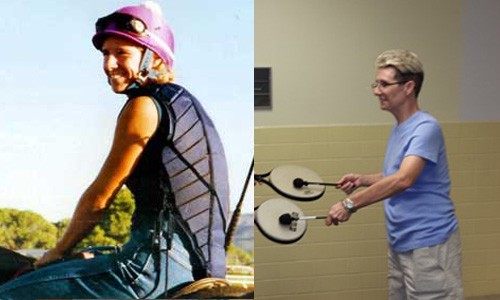
From schoolteacher to jockey, Stacy Burton chased her passion and earned her jockey’s license in 1999, riding at fair meets and smaller tracks across Arizona and West Virginia. Though her time in the saddle was brief, she embraced the sport with courage and determination. Today, Stacy’s story reminds us that love for racing knows no boundaries.
Unlike many jockeys, Stacy wasn’t born into the horse racing business. She was a teacher for 14 years, but loved racing so much that she spent the final three years of her teaching career exercising and training horses during the summer months. In 1999, she took out her jockey’s license and began to ride at fair meets, small tracks and, ultimately, at Turf Paradise in Arizona and at Mountaineer in West Virginia. Then tragedy struck. In a race in August 2000, Stacy’s horse hit a rider-less horse running the wrong way. The race was run in poor visibility and there was no time to react: Stacy’s horse and the runaway collided at full speed, catapulting her high into the air and changing her life forever.
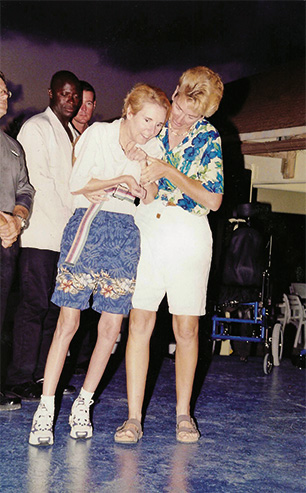
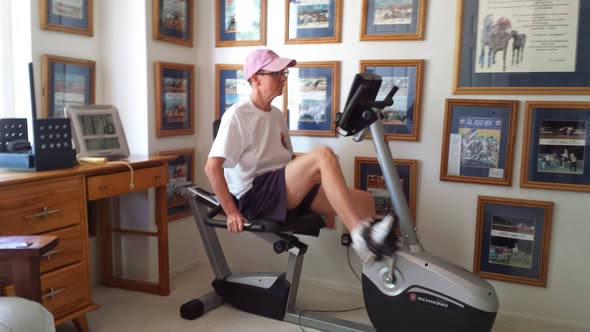
Stacy suffered such severe brain injuries that doctors gave her little chance to survive. They removed a portion of her skull to allow swelling to subside, and the jockey lay motionless in a coma for three weeks. But she did survive, thanks to intensive medical attention and the care of her longtime partner, Jan Hortyk. Stacy now speaks and walks with great difficulty and doesn’t remember much about her riding career. She has a pump implanted in her abdomen to deliver medication for constant pain and she has endured countless surgeries. The financial drain has impacted her life both physically and emotionally. She requires constant care. Money from a financial settlement with the racetrack and insurance is long gone.
The PDJF has come to Stacy’s aid by providing financial assistance to pay a mountain of medical and legal bills. Her condition has deteriorated over the years, according to Hortyk, but Stacy remains a fighter. Her monthly PDJF stipend helps pay for weekly music therapy, a nurturing environment where singing and playing instruments stimulate her brain as well as her spirit. The stipend defrays the cost of caretakers and medicine as well as the purchase and maintenance of a powered wheelchair that helps Stacy get out and about.